We remain fully operational. Our teams are working around the clock to ensure your deliveries continue safely.

DOWNLOAD THE APP


Copyright © 2025 Desertcart Holdings Limited
DOWNLOAD THE APP
Buy anything from 5,000+ international stores. One checkout price. No surprise fees. Join 2M+ shoppers on Desertcart.
Desertcart purchases this item on your behalf and handles shipping, customs, and support to Fiji.
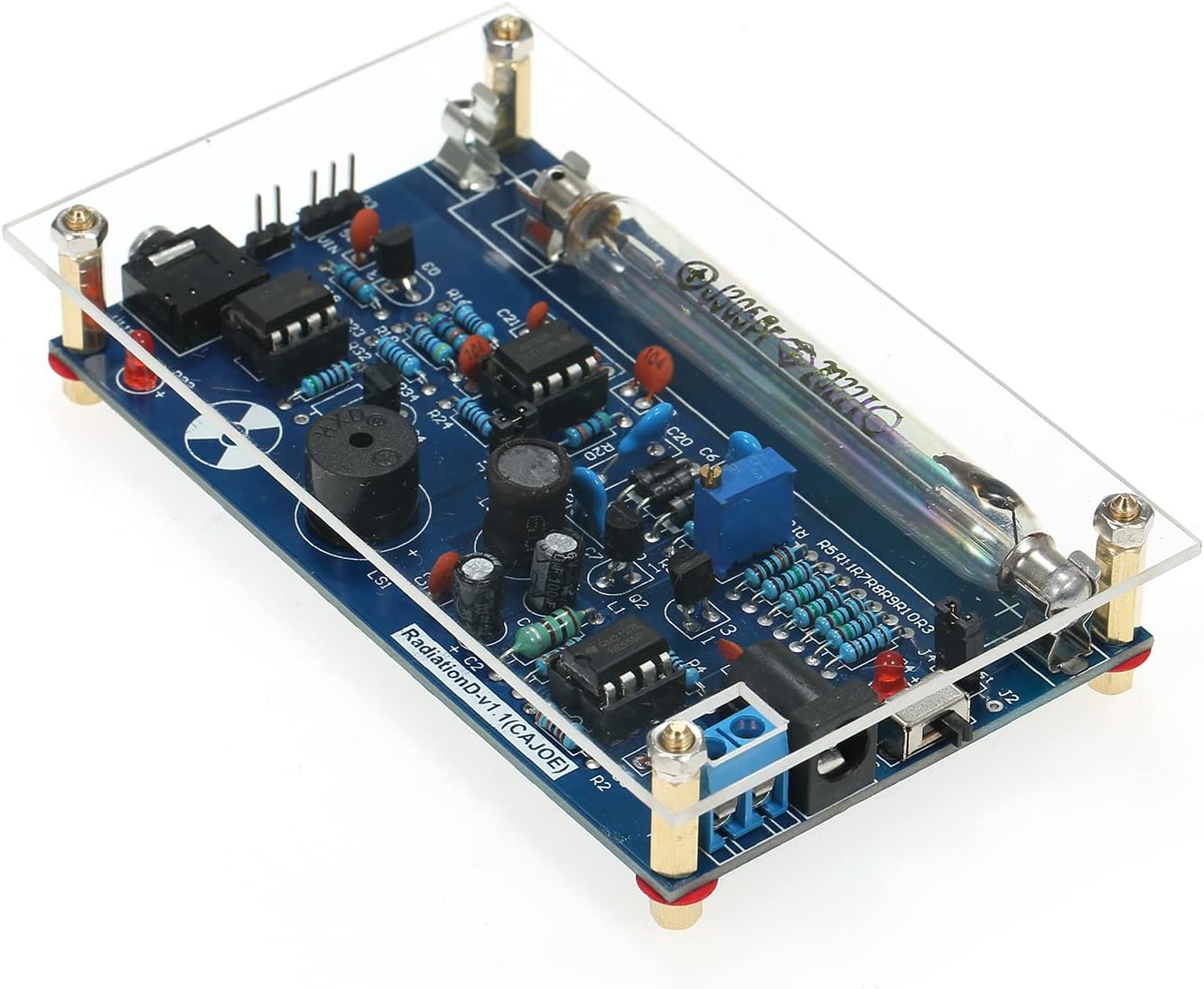
Buy Shkalacar Assembled DIY Geiger Counter Kit, DIY Nuclear Radiation Detector Kit with Miller Tube, Portable Geiger Counter, Assembled Radiation Detector System Experimental Module: Power Entry Modules - desertcart.com ✓ FREE DELIVERY possible on eligible purchases Review: I want another - Love it. You will get around 25 - 30 pulses per minute background. Right near the inside of a smoke detectors opened unit, it will pulse a bit too fast to count without using a circuit/Arduino for that. You can hear there is elevated radiation and it is quite a sensitive tube. You can shut the unit up by removing a jumper, perhaps replace it with a switch? I would be happy with just this but you can go a step further and hook the output to a computer, Raspberry Pi, or Arduino. There is one issue though, but it's not the fault of this unit, you can get these very accurate and use it on an Arduino to measure uS/H (microsieverts per hour) , you can compensate to mearsure radiation in a linear fashion. The thing is you will sledom get the actual conversion rate for this particular tube since the sellers don't know what it is themselves. There is also other confusion involved. I will post a pic of some of the popular geiger/Muller tube info data. It comes with a J305 tube. If you replace it with a Russian tube make sure to calculate the rate according to their data sheet. This is the correct conversion for the j305 : 0.0038 = strait conversion 301.03 = 0.0033 compensated for absorbtion. I will also include a circuit diagram. Unit calibration is available online but only needed when you purchase units you have to build yourself. Review: Great device for education purposes. - Good product.


| ASIN | B09X1H5CW4 |
| Brand | Shkalacar |
| Customer Reviews | 4.2 4.2 out of 5 stars (52) |
| Date First Available | April 1, 2022 |
| Item Weight | 5.3 ounces |
| Manufacturer | Shkalacar |
| Manufacturer Part Number | GLD7448456567224NB |
| Package Dimensions | 5.94 x 4.02 x 1.61 inches |
G**I
I want another
Love it. You will get around 25 - 30 pulses per minute background. Right near the inside of a smoke detectors opened unit, it will pulse a bit too fast to count without using a circuit/Arduino for that. You can hear there is elevated radiation and it is quite a sensitive tube. You can shut the unit up by removing a jumper, perhaps replace it with a switch? I would be happy with just this but you can go a step further and hook the output to a computer, Raspberry Pi, or Arduino. There is one issue though, but it's not the fault of this unit, you can get these very accurate and use it on an Arduino to measure uS/H (microsieverts per hour) , you can compensate to mearsure radiation in a linear fashion. The thing is you will sledom get the actual conversion rate for this particular tube since the sellers don't know what it is themselves. There is also other confusion involved. I will post a pic of some of the popular geiger/Muller tube info data. It comes with a J305 tube. If you replace it with a Russian tube make sure to calculate the rate according to their data sheet. This is the correct conversion for the j305 : 0.0038 = strait conversion 301.03 = 0.0033 compensated for absorbtion. I will also include a circuit diagram. Unit calibration is available online but only needed when you purchase units you have to build yourself.
A**N
Great device for education purposes.
Good product.
S**R
Kinda fun - a curiosity
I bought the assembled version. There's literally zero documentation provided with the module, but easy web searches and ChatGPT queries will tell you all you need to know about the CAJOE (manufacturer's name printed on module) geiger counter module. I powered it up and it clicks away at the (presumably) background radiation level. I am searching around for something in my environment that might be radioactive to see how it does. Right now I do not know if these are random clicks, or actually mean anything. I will be building a little microcontroller based UI to translate and present the readings and house it in a 3D printed case. Just a quick addendum: The VIN output - which is the output pulse if you are feeding a downstream circuit - is VERY high impedance. Any sort of load will corrupt the signal. I found I could only feed it into the gate of a FET before using it for anything downstream of this module. That's fine, since it is a 5V signal and I needed to feed it to an ESP 32, which is 3.3V only, and I had to level shift anyway. A simple resistive divider would not do it though, since even the load of a very high resistive divider would corrupt the signal and you wouldn't see any output. It only loses a star due to the complete lack of documentation.
S**Y
Excellent circuit to use when learning basic arduino integration with thingspeak
Ordered this as a fun project to play with over a rainy weekend when I found it available as a next-day. Only critique is the holes on the plexiglass are off just a tiny bit. Enough that it forces the upper one to bow upwards if you force all four screws into place. Not a show stopper, just a quality issue on the drilling precision. Interesting to see how much random radiation is around. Nothing significant, just enough to register at times. Setting it up with a thingspeak account via arduino to track results over time was a fun way to spend a rainy weekend.
T**D
Works but no instructions
Documentation is lacking
G**X
Annoyed by a few things
All right so does it work yes however it did not come with instructions. Also I thought I was going to be assembling this. I didn't do any work the circuit board I just plugged into Geiger tube plugged in some batteries and that's pretty much it. I mean it can be programmed with adrenos that's pretty cool. I need to get more gear so I can actually make this a usable Geiger counter. Quality is actually quite good though and I can only hope that I can make it more accurate kind of hard to tell when there's no means of actually showing it. It's also a decent it's also a decent size. You could definitely strap it to your arm or keep it in your pocket. Something like that
O**R
Geiger counter
No instructions need a case
M**S
fonctionne bien
A**I
It worked pretty well but the tube it came with was broken, i had a spare one so i didnt have to return it.
D**T
Der Spaß beim selber Löten ist garantiert. Abgleich für mich problemlos. Genaue Anweisungen (notfalls googeln) befolgen. Arduino-Anschluss war für mich kein großes Problem... und ich bin nur Hobbyelektroniker.
M**O
Inizialmente ero perplesso ma devo dire che fa il suo dovere.
D**Y
A nice device for hobby/DIY projects. It works now on my balcony to submit data to the GMC map.
Trustpilot
2 days ago
2 months ago